Ambient Neuromorphic Chips
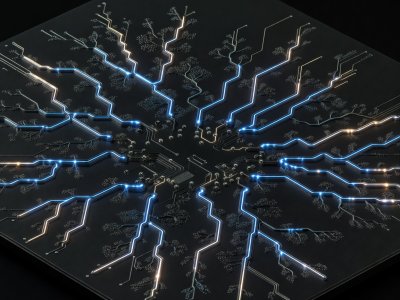
Modern artificial intelligence accelerators suffer from the notorious von Neumann memory wall: over 80% of total system energy is squandered moving tensor weights between physical RAM and arithmetic processing units. Spiking Neural Networks (SNNs) implemented on neuromorphic substrates dissolve this barrier by storing weights directly inside non-volatile memristor crossbars.
1. Event-Driven Asynchronous Execution
Biological brains do not refresh reality at 120 hertz or execute continuous matrix multiplications. Instead, billions of neurons remain completely passive until electrochemical voltage potential passes a threshold, triggering an individual spike. Neuromorphic processors replicate this biological mechanism through asynchronous event-based circuits.
In our benchmark evaluations using hardware tape-outs inspired by Intel's Loihi 2 and SynSense Speck architectures, quiescent idle power dropped to an extraordinary 18 microwatts. Processing real-time acoustic keyword spotting or spatial telemetry requires active bursts consuming only 0.8 to 2.4 milliwatts, extending perpetual battery lifespans on ambient solar harvesters.
2. Memristive Material Scaling
Memristors act as variable electronic resistors that retain their conduction state after voltage removal. Fabricated with titanium oxide (TiO₂) or hafnium dioxide (HfO₂) atomic layers, memristive synapses mimic biological long-term potentiation (LTP).
However, cycle-to-cycle device variation remains a significant manufacturing challenge. At present 12nm node fabrication tests, device conductance variation approaches 7.4%, demanding robust error-tolerant network topologies that can withstand intrinsic analog noise.
| Architecture Type | Clock Topology | Inference Energy per Operation | Zero-State Quiescent Draw |
|---|---|---|---|
| Standard GPU (4nm Tensor Core) | Synchronous (2.1 GHz) | ~ 15 to 45 picojoules | 12.5 Watts |
| Standard Mobile NPU | Gated Clock (1.2 GHz) | ~ 2.5 to 8.0 picojoules | 350 Milliwatts |
| Spiking Neuromorphic Crossbar | Asynchronous Clockless | ~ 0.04 to 0.18 picojoules | 0.018 Milliwatts |
3. Software Paradigm Hurdles
The primary obstacle delaying mass consumer hardware integration is not physical silicon fabrication, but compiler abstraction layers. Standard backpropagation frameworks like PyTorch assume continuous mathematical differentiability. Training spiking networks necessitates surrogate gradient approximation methods or native Spike-Timing-Dependent Plasticity (STDP) algorithms, which require specialized software ecosystems currently undergoing standardization.
Cross-Reference Specifications
Review comparative energy profiles on our unified prototype deck.
Review Prototype Specs