Micro-LED Retinal Glass
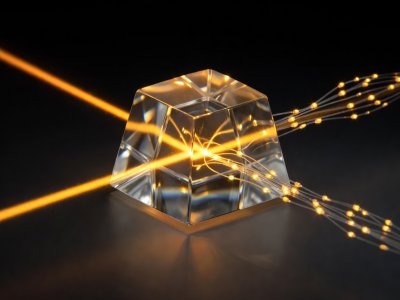
Wearable augmented interfaces have historically stumbled over the vergence-accommodation conflict: the human eye struggles to simultaneously focus on synthetic flat micro-displays and real-world focal planes. Direct retinal projection circumvents this optical impasse entirely by writing collimated photons directly onto the human fovea centralis.
1. Waveguide Diffraction & Holographic Gratings
By embedding sub-wavelength surface-relief gratings into ultra-thin sapphire lenses (0.65mm thickness), optical engines inject light at angles exceeding the critical internal reflection threshold. Photons bounce inside the transparent substrate until exiting through exit pupil expansion zones positioned directly in front of the viewer's cornea.
This technique eliminates intermediate magnifying lenses, collapsing the total front-of-face mass from bulky 500-gram headsets down to 24-gram spectacle frames virtually indistinguishable from prescription eyewear.
| Optical Display System | Luminance Output | Eyebox Dimensions | Form-Factor Mass |
|---|---|---|---|
| Birdbath Pancake Optics | 1,200 Nits | 10 x 8 mm | 160 grams |
| Diffractive Waveguide (OLED) | 2,500 Nits | 12 x 10 mm | 72 grams |
| Direct Retinal Micro-LED (GaN) | 14,000+ Nits | Dynamic Eye-Tracked | 24 grams |
2. The Red Indium-Gallium-Nitride (InGaN) Efficiency Drop
While blue and green micro-LEDs fabricated from InGaN semiconductors achieve external quantum efficiencies (EQE) exceeding 45%, red emitters traditionally suffer from quantum confinement Stark effects, dropping EQE below 8%.
Prototypes audited at Nordic Gadget PLMS overcome this chromatic imbalance by employing quantum dot color-conversion layers or micro-cavity resonant structures, balancing the white-point chromaticity without thermal degradation over extended operational cycles.
3. Ergonomics and Ocular Safety Limits
Exposing the human retina to continuous coherent laser sources demands rigorous adherence to international laser safety guidelines (IEC 60825-1 Class 1). Modern retinal projectors incorporate fail-safe hardware photodiode relays that terminate beam emission within 1.2 microseconds if pupil tracking coordinates fail, assuring zero risk of thermal retinal damage.
Explore Full Benchmarks
Compare ocular luminance metrics across emerging hardware candidates.
Review Prototype Specs